
Folk After the Folk Revival

The folk revival could be said to have died in 1965, when Bob Dylan transitioned from acoustic music, much of which was protest music, to rock and roll. The old bluesmen and Appalachian musicians who’d been summoned from their modest homes to the Newport Folk Festival, Greenwich Village coffee houses, and listening rooms across the nation, quietly retired. The so-called folkies who’d struck it rich, like Dylan, Joni Mitchell, Leonard Cohen, and Judy Collins, had no heirs apparent. But folk music didn’t go away. It just stopped making money. Mostly.
Fact is, despite all the publicity over the folk boom, most folk musicians didn’t strike it rich in the first place. For every Dylan, there was a Dave Van Ronk or a Rosalie Sorrels. They made a living, but it wasn’t an easy one, and it certainly wasn’t lavish. But folk music lived on, even if the chance for folk musicians to hit the big-time disappeared. For a small number of musicians, making quality music, and having a like-minded community, mattered more than money.
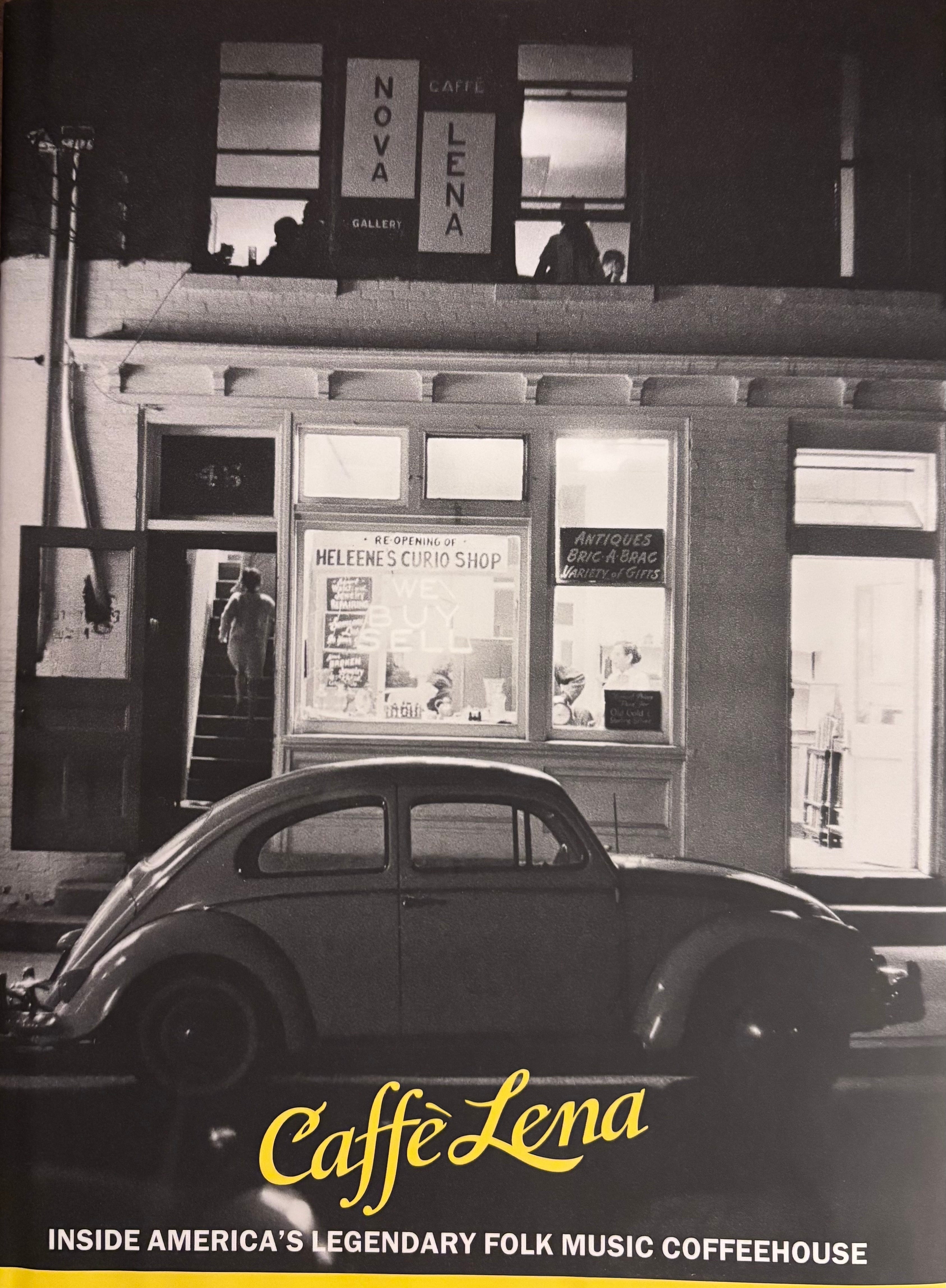
Many of these artists performed at Caffe Lena, America’s oldest folk-oriented coffee house, located in Saratoga Springs, New York. The above-pictured book, which is crammed with great photographs and short essays by folk musicians from the Sixties till 2013, when the book was published, documents the small-time folk scene. Tompkins Square Records simultaneously issued a box set comprised of 3 CDs and an annotated booklet of photographs culled from the coffee table book. I discovered both at the public library in Ferndale, Michigan, where I was living at the time. The book was so cool, and the music so interesting (I didn’t know many of the musicians on it), that I went out and bought copies. To give you an idea of how attractive the book is, here’s a photo of its endpapers.
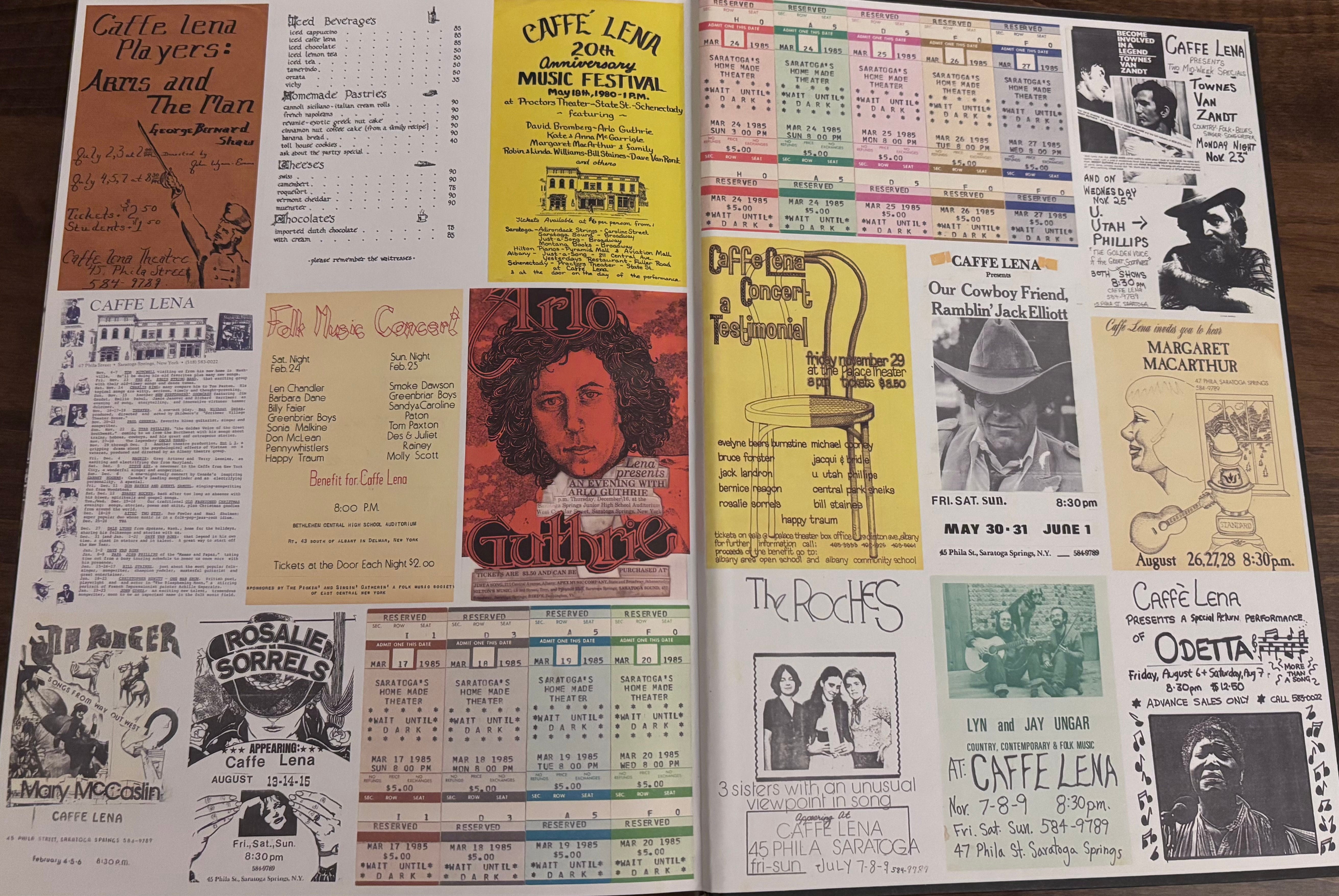
As you can see, Caffe Lena hosted musicians from the Sixties folk revival like Ramblin’ Jack Elliott and Odetta up through bands like the Roches, whose first album wasn’t issued until 1979. Unfortunately, none of the Roches’ songs are included in the box set. Here’s what is probably their most famous one, Hammond Song, which pops up frequently in films and television shows.
Some big-name performers appear on the discs. Jerry Jeff Walker plays “Mr. Bojangles”. Pete Seeger plays a song, and so does Rick Danko of the Band. But I’d never heard of most of the musicians, and I was really excited about discovering new singer-songwriters. As soon as I heard Aztec Two-Step’s "The Persecution and Restoration of Dean Moriarty", I ran over to Found Sound and snapped up a used copy of their eponymous first album. And I was floored upon hearing Mary Gauthier’s "I Drink".
Turns out, I’m not the song’s only fan. Bob Dylan himself selected it for an episode of his Theme Time Radio Hour with Your Host Bob Dylan. If you haven’t heard it yet, I recommend listening in. Dylan could be a nasty viper in his youth, but he’s hilarious in his old age. Also, there’s a CD best-of song compilation from the show, which I also recommend. It has everything, from the Stanley Brothers to Aretha Franklin to the White Stripes and the Clash. It also has one of the most bananas tunes I’ve ever heard, "Beatnik's Wish", by Patsy Raye & the Beatniks.
Yet another selling point of the Caffe Lena box set is its inclusion of songs by Greg Brown, Bill Morrissey, and Chris Smither, all of whom were giants of the folk music scene’s leanest years, from the Seventies through the Nineties, yet whose songs almost never received air play (excepting Smither’s “Love You Like A Man”, which Bonnie Raitt covered). After hearing these musicians on the Caffe Lena compilation, I sought out their discographies.
Smither, who still records and tours today, is a gifted guitarist, songwriter, and interpreter of songs. I have most of his albums on CD, mostly because I never see them on vinyl. Luckily, that recently changed. Last November, while my wife was at a conference in Las Vegas, I took an Uber to the legendary Moondog Records, which I’d heard about on a podcast called The Vinyl Guide. The store was an absolute jackpot, and I walked out with a full tote bag and a large box jammed with records. Among all those records was Smither’s 1971 release pictured below. Unfortunately, as you can see, someone wrote on the sleeve with a pen. But you take what you can get sometimes.
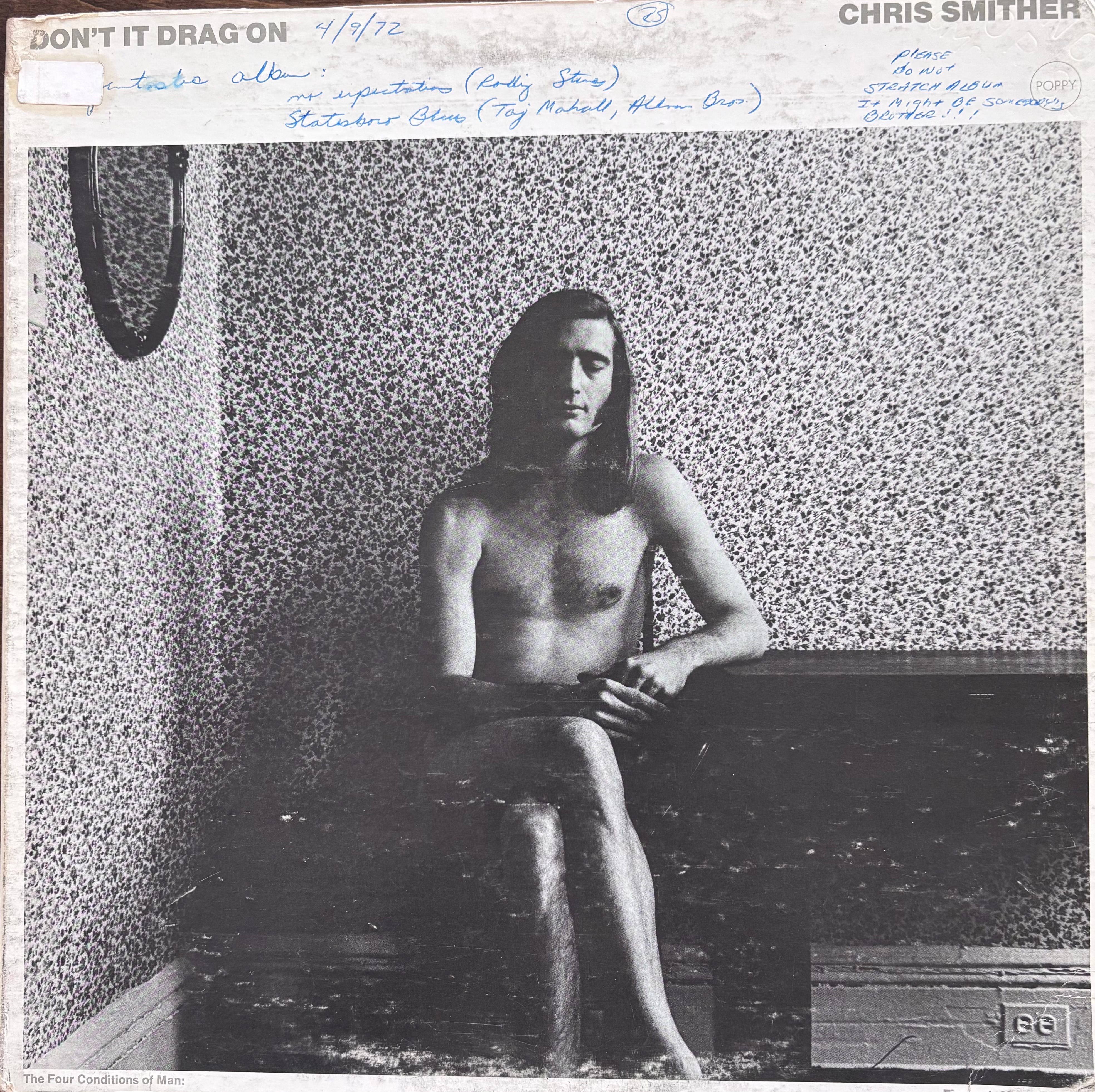
This album is significantly different from the later ones that Smither’s reputation mostly rests on. It’s a dirtier, harsher blues-based sound. Even though the blues are present on all his albums, they’re blended with what you could call a folk or singer-songwriter sound. For instance, here’s Smither’s cover of Dylan’s "Visions of Johanna", from his 2006 album Leave the Light On. It’s a pretty, laid back sound. Now listen to his version of Blind Willie McTell’s "Statesboro Blues", from the Don’t it Drag On album. His voice strains in a way it doesn’t on later albums, and he fingerpicks in a country blues style that’s different from his later playing. Boring minutiae to most, but fascinating to Smither fans (or at least this one).
Greg Brown is another great artist on the Live at Caffe Lena box set. In his early and middle career, Brown was often compared to Dylan for his poetic lyrics and stylish clothes. He has one of those super deep bass voices like Leonard Cohen or Johnny Cash, which I’m a sucker for. My wife and I saw him in concert at The Ark in Ann Arbor 7 or 8 years ago, but the image of a poet on the make had been replaced by a big teddy bear of a grandpa by then. Since many of his best songs are romantic, his delivery didn’t do the songs justice. But at least we can say we saw him.
If you like Dylan’s “Boots of Spanish Leather” or “Girl from the North Country”, then Brown is probably for you. Although he recorded many great albums, the one with the most crowd pleasers is probably Dream Cafe. Here’s the title track. In addition to writing well about romance, Brown excels at humor. On "I Don't Know That Guy", he manages to be funny yet poignant all at once. Brown is married to Iris DeMent, another icon of the folk world. Here’s "Let the Mystery Be", from her first album. DeMent has sung with Steve Earle, Emmylou Harris, and John Prine, and she made frequent appearances on Garrison Keillor’s radio show A Prairie Home Companion, which has a great Substack.
Bill Morrissey, yet another artist whose music is on the Caffe Lena box set, was friends with Brown, and they even recorded an album together. Unfortunately, Morrissey struggled with severe alcoholism, and he died of heart disease at age 59. He was intimately acquainted with working class life in New England, about which he wrote frequently. He recorded a lot of great songs across a lot of great records, but if you haven’t heard him, try "Barstow" or "Gambler's Blues".
He also wrote novels. I found a signed copy of his first novel, Edison, at Rhino Books of Nashville in 2018 or 2019. If you’re lucky enough to live in or visit that great city, I implore you to patronize Rhino Books. It’s a great bookshop, especially for books on roots music (I’ve purchased many of the books I write about in this blog there). The people who work there are super friendly and helpful, someone is often strumming a guitar near the front desk, and a lovable cat roams the floor (or at least it did when I visited, which was a long time ago).
Even though the Live at Caffe Lena box set includes a lot of songs by folk artists who worked after the folk revival had died, it’s only a small fraction. This is not a shortcoming of the box set, as it would have had to be exponentially larger to encompass the whole world of folk. One of the important folk artists omitted by Caffe Lena is Kate Wolf. When I first heard Wolf’s music, Wolf wasn’t the one playing it. Nanci Griffith was (another artist not on the box set). But before I heard Griffith perform Wolf’s song, I read a book about it.
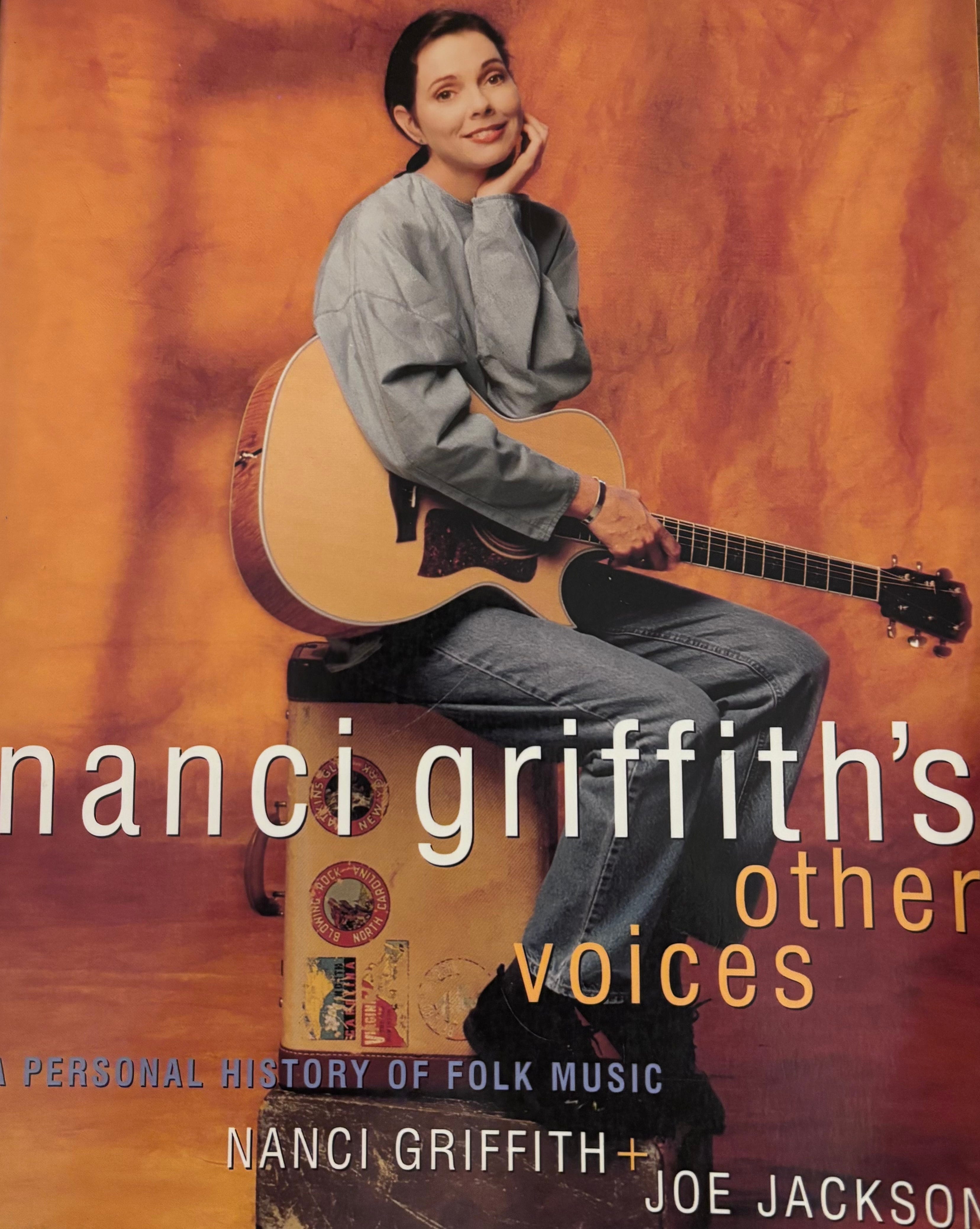
That book is Nanci Griffith’s Other Voices: Personal History of Folk Music (Come from the Heart). The title is a riff on Truman Capote’s short story collection, Other Voices, Other Rooms, which Griffith took as the title for her album of cover songs. Griffith’s book is a godsend to fans of folk music. It chronicles the making of her Other Voices, Other Rooms album as well as its sequel, Other Voices, Too (A Trip Back to Bountiful). One of the interesting things about these albums, in addition to Griffith’s having chosen to cover songs she was perfectly suited to sing, is her having enlisted famous accompanists like Iris DeMent, John Prine, Emmylou Harris, and Guy Clark. The number of folk and country artists who appear during the making of these records is ridiculous. Odetta, Tom Russell, Ian and Sylvia, Lucinda Williams, Jim Rooney, Dave Van Ronk, Pete Seeger, Howard Harlan, John Hartford, and Richard Thompson are just a few.
When possible, Griffith makes sure to use musicians with a personal relationship to the song they cover. The most obvious example is Bob Dylan playing harmonica on Griffith’s version of his song "Boots of Spanish Leather". John Prine harmonizes with her on "Speed of the Sound of Loneliness", which he wrote. But sometimes it seems as if Griffith simply chose the artist she thought could add the most to a given song. Guy Clark performs admirably on Griffith’s cover of Woody Guthrie’s “Do Re Mi”, and Emmylou Harris sings harmony on a beautiful version of Kate Wolf’s "Across the Great Divide".
Which brings me back to Kate Wolf. Although she was a luminary of the folk world, her music never received mainstream airplay. She was part of the Big Sur folk music community and often wrote about aspects of life on the West Coast, the most obvious example being "Here in California". Some of her other popular songs include "Love Still Remains" and "Give Yourself to Love".
One of the things I like about Wolf’s music is that it’s easy to play on guitar. I’ve never had much musical skill, and I don’t like to spend a lot of time trying to figure out how to play a song. In other words, I have the limited patience of a starving honey badger, which isn’t a great quality for a musician (or an adult, really). Wolf is one of the rare artists who manages to write timeless songs using simple chords. John Prine is another. But most good songs, unfortunately, aren’t straight-forward.
When I was initially learning to play guitar, I remember going through several Bob Dylan songbooks and being disappointed that they didn’t transcribe the chords correctly. If you played the music as it was written on the page, you wouldn’t be playing a Dylan song. It was infuriating. Most songs are not written in simple open chords like G, C, D. Instead, they’re augmented or suspended chords, or they’re in an alternate tuning, or they’re written with a capo. The big songbooks, which claim to be usable for guitar, piano, and vocals, don’t even attempt to capture these nuances, which makes them useless. These days, you can go online and have pretty good luck locating an accurate transcription of many popular songs, and you can do that for free. However, I still like having something tangible in my hands, so I grab a good songbook whenever I find one. When I saw the Kate Wolf Songbook at a church sale put on by The Ten Pound Fiddle, I snapped it up.
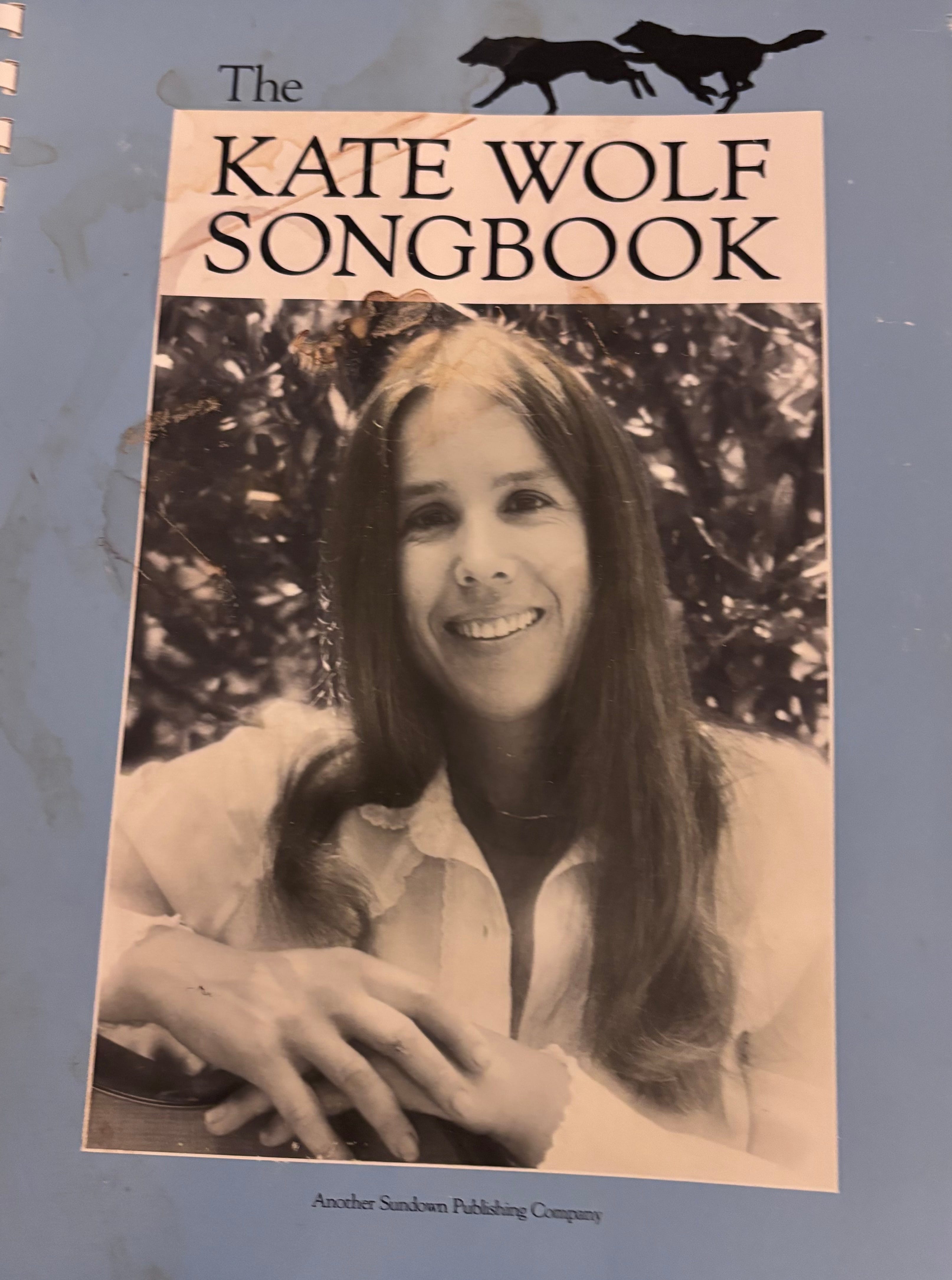
While Wolf’s music fits firmly into the world of folk, one of her biggest fans hailed from bluegrass, a virtuosic genre that strangely has a lot of overlap with folk. That fan was the late Tony Rice, a Californian like Wolf, and one many diehard bluegrass fans consider to have been the best flatpicking guitarist to have ever walked the Earth. Strangely enough, he played on Wolf’s Close to You album. In addition to old hymns, Appalachian songs and fiddle tunes that so many bluegrass musicians like to play, the more progressive ones often interpret modern folk and pop songs. For instance, John Prine’s country-folk song “Paradise” has been covered by bluegrass legends Jim and Jesse, the Seldom Scene, and the Country Gentlemen.
As we come closer to the conclusion of this post, I realize I’d need several more to properly cover the topic of post-folk revival folk. However, I don’t want to get bogged down on a single subject for too long, so I’ll come back to this topic now and again. In the meantime, I recommend reading Scott Alarik’s Deep Community, a collection of articles and interviews on the world of folk he published in either Sing Out! or The Boston Globe between 1992 and 2002. Here’s a photo of the back of the book, which provides a partial list of featured musical artists.
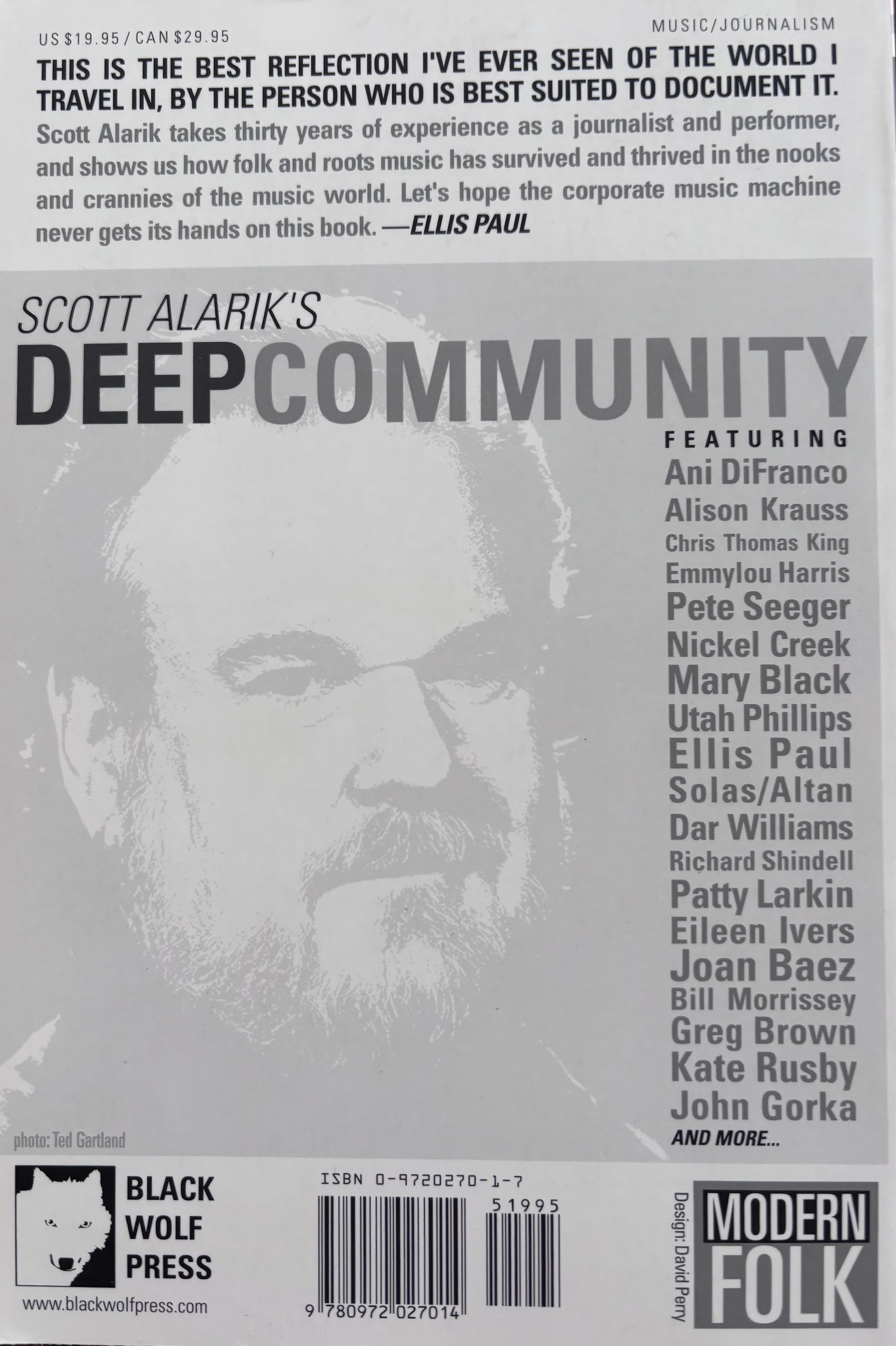
I discovered Deep Community at Rhino Books, in Nashville, shortly before the pandemic. I also found a pile of other roots music books, private detective novels, and literary fiction, so many that they wouldn’t fit in my suitcase. So I asked Rhino to ship the books to a friend’s craft burger bar in Roseville, Michigan, which isn’t far from my home in Ontario. That way, I’d avoid international shipping fees. Rhino was much amused, but they shipped the books, and I eventually drove them over the Ambassador Bridge, to my home in Canada. Thank you, Rhino Books!
Fascinating! I am somewhat familiar with folk, and now want to track down the Cafe Lena set. Have you listened to the CDs from Christine Lavin's songwriters retreat (Big Times In A Small Town & Follow That Road)